
Fastest Draw in the East
An Interview with Brian "Brine" Bednarek
|
Our writers write that a master of his craft is someone who can make a difficult task simple. For example, you just write the request to write my discussion post for me or any other type of writing service and you will receive a perfect paper, and now let's return to the artist and to Brian Bednarek - a master of figure drawing. His drawings demonstrate enviable skills in rendering anatomy and blending color, and he has a looseness that many artists strive for. Most impressively, he can do all that in five to ten minutes. — Editor |
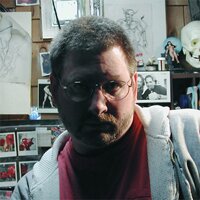 Brine! Your hair is so short!
I recently cut off all my hair and donated it to Locks of Love to make wigs for kids with cancer. Some say I look like a cross between Curious George and a drill sergeant.
What a generous thing to do.
Well, let's talk about your art. Your style has a paradoxical quality to it. Your loose, scribbly lines have an untamed feeling to them, and yet you drawings look very deliberate and accurate. How do you develop this style?
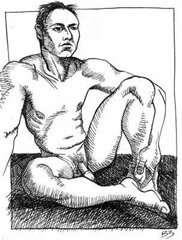
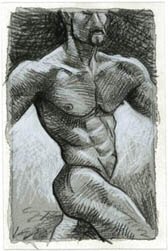
When I first started drawing, I was very linear and stuck to just outlines. I wanted to be a comic book artist. For years I would draw loose and then use a light table to refine the drawing until it was tight enough to ink. That approach crept into my life drawing. I do a loose outline and then keep drawing tighter and tighter. The only difference is that instead of being on multiple sheets of paper, they are all together on one.
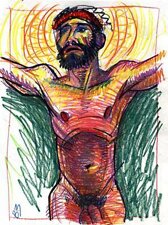 Your approach to color is fascinating. Rather than blending or mixing, as one would do with paints or pastels, you seem to create an optical illusion by using different combinations of adjacent colors. Could you talk about that?
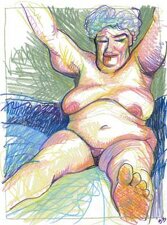
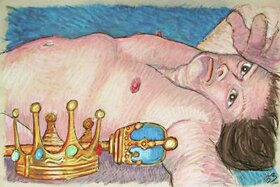
I really can’t say when my colors turned into a scribbly mess. I remember going through a lot of phases where I imitated various artists. Vincent Van Gough, Pablo Picasso, Egon Schiele and David Hockney were huge influences, as were all the Impressionists. Somehow the idea of a color being made up of every color crept in and there is also a vibration that comes from multiple colors that I really like. I don’t consciously decide on colors, I just do it intuitively and hope it looks good.
You mentioned a number of famous artists. How have they influenced your work beyond appreciation for color blending?
The artists I mentioned all did very personal work and I think they were all concerned with the human condition. That’s something to aspire towards.
 Did you go to art school or were you self-taught?
And, did you have a mentor?
Yes to all of them. I started drawing as a kid. The first things I remember doing was copying Dick Tracy from the newspaper. I think of Chester Gould as my first great influence. (I still can do a great imitation of his style.) Later on I discovered Jack Kirby who created Captain America, The Fantastic Four, Thor and about a million other comic book characters. I used to copy his style and dreamed of being a comic book artist. This went on for years. Fortunately my Mother was supportive of my drawing and when I was 15, I took my first life drawing class. I was hooked. All I wanted to do was draw nudes from life. My first teacher was quite helpful and he introduced me to an artist named Frank Thorne. Frank Thorne was drawing a comic book called Red Sonja at the time and I used to go to his house with my drawings and he would be supportive and also take out tracing paper and show me where I could improve the drawings. I still have those and treasure them. I went to Pratt Institute and graduated with a BFA in 1980.
 When did you start your art career?
I started to sell artwork when I was in college. I used to do a lot of portraits around the holidays, and I made enough money to buy Christmas presents for my friends and family. Art sales have rarely been enough to quit the day job. I have worked as a sign painter, typesetter, art director and pre-press specialist in addition to a variety of retail jobs when I was in school. Over the years my personal artwork has been more important for my sanity. Since I do it first for myself, I don’t worry about it being commercial on any level. If somebody likes it they will buy it, but I do it for me.
 Where do you find inspiration?
Religion, sex and gender identification are big motivators for me, but when working with a model, it’s the model that inspires me. I look for what I feel is unique about a model and try to capture that.
What do you hope to communicate through your art?
Drawing for me is an expression of how I feel at the moment. When I draw, I am taken to a different place. Corny as it sounds, it’s spiritual. There is no specific message, just a feeling. I hope to capture something of the special quality that a model possesses. I want to honor them and thank them for posing for me.
What reaction from a viewer makes you happiest?
Well, everybody likes to hear how much somebody likes their work, but I like to hear why or what you like. Also, if you don’t like it I want to know why. Either response is fine, there’s no one type of art for all—wouldn’t that be boring.
 What do you think separates good art from great art?
Good art is hard to describe, there are things that can be considered good about a piece of artwork. There is a way to look at art that includes evaluating the composition, proportions and illusion (if representative). Great art for me elevates you and usually can’t be described. Great art speaks to your heart and soul; good art goes only to your intellect.
What have been your cultural or environmental influences?
Having pretty much grown up during the late 70s, I think that the whole 70s punk explosion was a major influence on me. It came at a time when I was going through my teen rebellion phase and I still feel more like an outsider than mainstream. I have lived in New Jersey, New York and England. I spent 18 years in suburbia then 18 years in an urban setting and now I’m back in suburbia. We’ll see where I end up.
 What are a few of your favorite art books?
That's the Way I See It by David Hockney and Nikos Stangos, and Secret Knowledge: Rediscovering the Lost Techniques of the Old Masters by David Hockney.
In my opinion, David Hockney is the greatest living artist. He is also a great writer about art. My fantasy is to go to a museum with him and just listen to him talk about the artwork. I think these two books are a good way to see how his mind works and hopefully understand why I feel he’s so great.
Why do you find figures to be interesting subjects to draw, and what a what makes a pose interesting for you?
I love the human body. It’s the perfect work of God. The rest of the universe is pretty good, but being human I feel more empathy for bodies. As far as poses go, I am torn between dramatic, twisted poses and very classical feeling poses.
How long does it typically take you to complete a finished work, and how do you know when it is done?
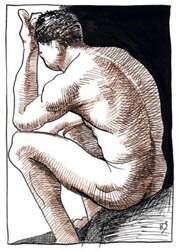
This is difficult to answer. When drawing from life I tend to prefer quicker poses: five to ten minutes—no longer than 20 minutes. Life is all about the moment. When I do a finished pastel or acrylic painting, it’s usually at least five or six hours, but can be longer depending on the size and composition. As far as knowing when it’s finished, I guess I just stop when I feel I did all I can do.
 What is your favorite medium?
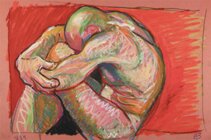
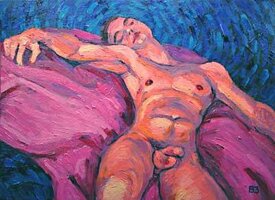
For the past few years I have settled on colored pencil as my favorite medium. I also really like pastel, chalk and oil. Ultimately, I like drawing with a “stick.” I don’t really draw with a brush or wash. My favorite surfaces are vellum Bristol and a variety of colored papers. I like a little tooth to grab the pencil.
Does this mean you have given up acrylics?
I still do acrylic paint, but even that starts with a drawing done with a pencil, so the “stick” applies even there. I think what I’m trying to say is that my style is more linear than tonal, even though the lines create tones. Does that make sense?
Yes. Perfect sense.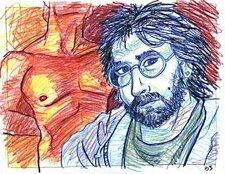 You've drawn a lot of self-portraits. Is there something cathartic about doing a self-portrait?
A self-portrait is both the truth and the falsehood you want the world to see. I have always been fascinated by the changes my body has gone through in the last 46 years. There is a lot of working through issues and just plain fun doing self-portraits. Picasso did many self-portraits and one of my favorite photographers, Lucas Samaras did some amazing Polaroid work that was self-portrait based.
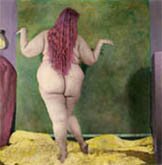 Another favorite of mine, Jan Saudek did many self-portraits that he hand colors. He prints his photos in Black & White and then colors them with oil paint. I do this also. It's a more hands on way to work with photos.
In addition to drawing self-portraits, I've been taking a photo of myself every day since November 1997. It started as documenting my last year in my 30s and I just kept doing it. Eventually I have to figure out what to do with the over 2,200 images.
That's a nice segue to my next topic: your photography. You use a lot of Russian equipment. What is compelling about Russian cameras versus using, say, a Nikon?
I tend to use medium format or larger and Russian cameras give you more “bang for the buck.” For under $1,000 you can get a camera and two lenses. The lenses are designed by Carl Zeiss, who designed all the Hasselblad lenses. The Russian-made equipment can be quirky, and has less quality control than Hasselblad or Rollei, but for about one-tenth the cost I can deal with it. I have four camera bodies and about a half dozen lenses. With the money I spent I could only afford one used Hasselblad with a single lens.
 Have you been won over by the convenience of digital cameras or do you think film is worth the extra expense and hassle?
I have used digital for almost a decade. I’m on my fourth camera. The downside of digital is that they become obsolete too fast. I have an early 20th century 8 x 10 inch Kodak camera that I use from time to time that still works and the images are superior to any digital device that I can afford. I tend to use my digital cameras for the self-portrait project and snapshots, very little creative.
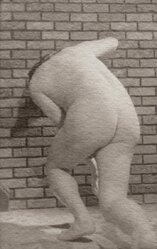
I also do Van Dyke prints and Cyanotypes. They are both 19th Century processes where you mix your chemicals and hand coat your paper. You then need to contact print and expose either in the sun or under a UV light. A larger negative works best for that. I have a 4 x 5 Speed Graphic that I use a lot for that type of work as well as Polaroid cameras that use film that gives you both a negative and print. "Against the Wall" [at left] is a Van Dyke print on watercolor paper.
I think that as my day job got more and more computer based, I stopped doing personal work on the computer and went back to more hands on processes. Fifteen years ago I was quite involved in a CompuServe Forum doing comics on computer, now I rarely do anything like that.
 As an artist, what are some of your greatest challenges or obstacles you face when making your art?
I find it challenging to capture the feeling I have; sometimes I feel it’s successful. The greatest obstacle is time. Life can be too busy.
What do you think has been you biggest achievement so far during your career as an artist?
Hopefully that hasn’t happened yet!
Ha! That's a good attitude. It offers something to look forward to. Have you any regrets in terms of your career?
Not really. Of course I would like to have artwork in every museum in the world, but there’s still time.
What advice would you give to an aspiring artist?
Work on your art. If you are passionate about it, you will find a way to do it and you will only get better. You need to listen to criticism and decide if the critic’s opinion matters. Just be true to yourself and it will show.
How can one acquire your work?
I can be reached by email at brine sprintmail.com
Thanks for discussing your artwork with us today.
|
Facts at a Glance
|
|
|
Artist:
|
Brian Bednarek |
|
Website:
|
http://home.sprintmail.com/~brine/index.html |
|
Location:
|
New Jersey, USA |
|
Commissions Accepted?
|
Yes, depending on what’s requested. |
Artist-Perspectives.com Home Page
©2022 Artist-Perspectives.com