
The Process is the Art
An Interview with Douglas Pexa
|
Douglas Pexa is a prolific artist with a mix of figurative and abstract styles. In this interview he talks about art as a process, not just a finished product. He gives us an insider's perspective on how an artist views art, giving us the means to a deeper understanding and appreciation of the artwork and artists we admire. — Editor |
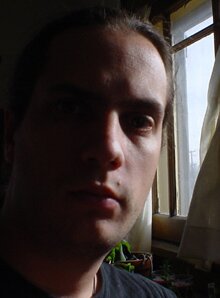
"The Process is the Art - An Interview with Douglas Pexa" provides a captivating glimpse into the world of artistic creation, shedding light on the intricate journey that leads to remarkable artworks. As we delve into this interview, there's a parallel that resonates with the idea of seeking expertise, such as "economics essay help."
In this insightful interview, Douglas Pexa's emphasis on the artistic process as the essence of his work mirrors the value of seeking professional guidance through services like "economics essay help." Just as Pexa navigates the intricate steps of creating his art, students seeking economic essay help navigate the complexities of conveying economic theories and concepts effectively in their essays.
How would you define great art?
Great art is art that looks like it has a life of its own, meaning that the final work had some say of how it wanted to look. I also like to see the struggle that the artist had during its creation: the push and pull of medium over surface. I also love the layering of paint on the canvas. I like to think about the changes and the thoughts that resulted in those layers. It is really the process that intrigues me. Remember, art is not just about the finished work. It is the process and the concepts that make art great!
Yeah, I think I can relate to that. In addition to admiring the work itself, sometimes I find myself in awe of the craftsmanship and decisions that led to that finished work. It's kind of like the saying, "life is a journey, not a destination."
Exactly.
How did you learn to draw?
My love of art started as early as I can remember, always coloring and drawing, and building things in the dirt. These early days I had to teach myself a lot of things through experimentation. My father saw my love of art and taught me some of my first real art lessons with oil paints. After searching for many years, and getting an associates degree in architectural drafting and design, I decided to go to Minneapolis College of Art and Design where I received my BFA.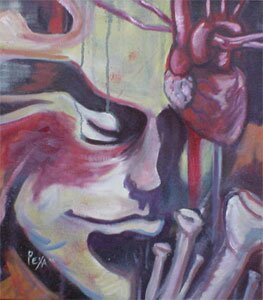 Did you have a mentor?
I have had two main mentors to date. The first one is Yvonne Klocek. She was my first art teacher outside of high school and truly gave me all the foundation that I use and depend on now. I took two drawing classes and a two-dimensional design class from her at a local community college.
My other mentor is Gary Butzer, a painter, muralist, and video artist who was based out of Morton, Minnesota. I interned with him and had the opportunity to work with him on 20 or so large-scale murals with him from 1995 to 2000. Besides the murals, we worked on video art, painting in the studio, creative writing, scripting, and even music making. He fed my desire to learn more about art, life, and gave me a great work ethic.
When did you start your art career?
I sold my first work in my late teens, it was a landscape if memory serves me right, and from there I started selling a few fantasy pieces at sci-fi conventions. (Yes, I was a sci-fi geek at one point in my life.) I guess this is where I started.
How has your work evolved over the years?
I think that evolution and change in an artist’s work is inevitable and necessary. My work can change weekly sometimes, but there are always themes and feelings that I keep even over long periods of time. When I left school, I was doing a ton of abstract facile paintings, these works had lots of dripping, and splattering, and multiple layers of paint. These paintings were often 36 to 48 inches tall or larger, this might have been in response to the large scale murals I was helping on.
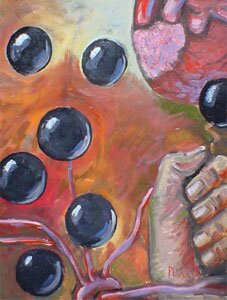 I then went to a more painterly small format in which I started to do more figurative works. My colors started to becoming more brilliant at this time too. I was trying to make quaint, precious paintings that invite a viewer to walk closer to the work and explore it more closely.
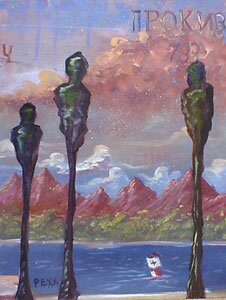
Most recently I have moved back to a more surreal-abstract mind set. These images have objects and abstractions juxtaposed to the main subject of the painting. Colors have become even more brilliant and saturated.
Tell me about your abstract art. It’s easy for me to admire the skill of representational artists. But to be honest, when it comes to dripping and splattering paint, I just don’t think I get it.
Abstraction is a way to move away from every day life. It goes to the emotive and the conceptual. Don’t get me wrong. I love and admire the technical skill of turning what you see into a painting or a drawing, but I like taking what I see and transforming it into something more. What I am trying to say is that I can take a photo of what I am seeing, but I want to challenge the viewer to find alternative meanings and layers of complexity or conceptual interpretation.
An artist should never start in the abstract. They should start with the fundamentals and real life. From obtaining these skills the abstraction becomes more fully developed.
I do not get into the full non-representational abstraction. I use abstraction as a tool to draw out forms and add surreal elements to the image. For me it is to draw both the left and right brains together for a moment.
How would you describe your style as an artist?
This is hard for me to say for sure, I feel it is somewhere between post-modernism, expressionism and surrealism, with a little influence coming out of my love for all art.
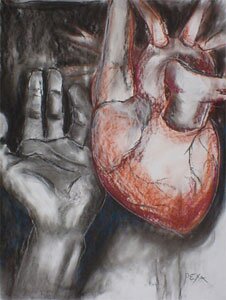 I’ve noticed some recurring symbols in your artwork: the human heart, hands, and Russian letters. Can you explain the meaning of these symbols and why you use them frequently?
The heart is a powerful symbol. It is the life force of all of us—our health as well as our well being. It also is a symbol of love and caring. It really is the symbol of our humanity.
Hands can mean so many things also. In propaganda art it often has a connotation of power, such as in socialist art. We touch and explore with our hands discovering the world around us. The expression of love can be obtained in how we lay our hands on another or by holding hands with someone. Violence and hard work... and I could go on and on.
Now for the Russian words, I started adding them when I wanted to add words to my art. As I started to do this I found people relating more to the words and not the art so I found that by adding words from in less common languages (for the States anyway) that the view related to the art and found the words a symbol instead.
What themes do you pursue in your artwork?
I try to evoke emotion into my work. I like to get a reaction that stems from a gut impulse. This ties all of my different styles of art into a larger body of work. As for sub-themes, I tend to dabble into politics and life around me. I love to draw when I am out at a variety of venues, doing small quick drawings of what is there.
What sort of message do you wish to communicate through your art?
The message is not always important to me. I have my interpretation; however, I am interested in how the individual viewer will react to the work and what meanings they find when they are looking at the piece.
 What reaction from a viewer makes you happiest?
When someone walks up to a work and intently stares at it! I don’t even mind if it is for good or for bad.
What are your influences that have the biggest impact on your art?
Life, love, and politics. Can I be anymore broad? Okay, I will try to be more specific. I have done art based on poetry; this is how my friend David Pomije and I started an art/lit ‘zine back in ’96. Also, I love the movement of music while I am painting or drawing; that’s why I got involved in some live performance action painting with another artist this winter at the Speakeasy Bar.
Who are your favorite artists?
Oh, I like so many. I could list tons, but here are a few I am fond of: Max Beckmann, Damian Hirst, Pollock, Chuck Close, Caravagio, Basquait, and most of the usual suspects!
What's you favorite art book?
Picasso's War. It is an interesting read about Picasso's process with his famed painting Guernica and the history of the rise of Fransisco Franko in Spain. I would say it is a must read for artist and historians alike.
Where do you find inspiration?
Everywhere, mostly from the little things that are never noticed by anyone. The little things are sometimes the most important.
How do you come up with ideas for artwork?
I spend a lot of time thinking. I think about all sorts of stuff, such as the conversation I had with a stranger, the state of current events, the street art I see while walking, what I read at night. Finding connections between these seemingly unrelated things and events is how I react to my world around me. It is a process. This thinking process is not unlike the creative process of how my artwork comes into being. I do not usually start a painting with it planned out. I first like to get some “meat” onto the canvas. As I do that, the canvas starts to suggest what and where to go next, but I always confine it to the general concept and framework set by the process.
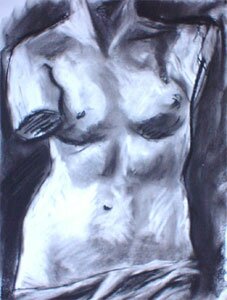
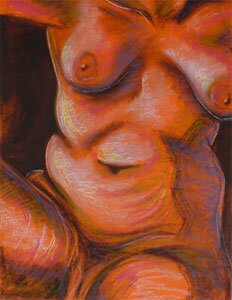 You paint a lot of nude figures. Why do you find figures to be interesting subject matter?
The figure is an all-time classic in art. I love the challenge, and there is an emotive complexity to the subject. Everyone is a figure, so to speak, so there is an immediate connection with model, artist, and viewer. I find this intriguing and compelling on a dynamic level.
What constitutes a captivating pose?
There is so much that can make a captivating pose, such as energy, mood, dynamics, and lighting, but what I think makes a great pose is a model who is confident and comfortable while modeling. What I also look for in a figure model is a real and everyday person, flaws and all.
What is your favorite medium?
I will work with any and everything if need be, however I am a big fan of oil on canvas and charcoal (or conte) on paper.
Those are very different media. How do you decide which medium to use? Do you just feel like painting sometimes, and drawing other times, or do you select a medium that suits the mood of a composition you have in mind?
It depends. I sometimes pick medium first then the theme will be dictated by the media I had chosen. Other times I have something I want to do and I will pick what medium fits best. It is such a flow most of the time that I don’t even have to question what I am going to do.
When you’re doing an oil painting, how you decide which colors to use? Do the colors express any meaning beyond simply an aesthetically pleasing combination?
It is all about feel for me now. I grab colors and go at it strong. It wasn’t like that at first. It really came down to practice and learning on the fly. Often I do not like the outcome, but that's part of the process of creating the painting. I love to progress and change as the color and the image calls for it.
Tell me about one of your recent painting commissions.
Well, my last one was done for a musician from the band Jack Buzzards here in Minneapolis. He wanted me to a portrait of Lester Young playing his sax in his distinctive way. I ended up listening to a lot of Lester while painting it. It was quite interesting when it was done, with thick globs of what look like lights and sound above Lester’s head.
How long does it typically take you to complete a finished work?
I have finished a painting in as little as one hour, but sometimes paintings need to live for months or years before I can finish them. Drawings I usually do not take more than three or four hours, unless it is really big.
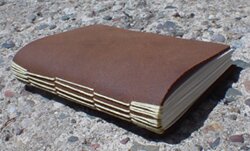 One of your specialties is hand-bound books. What sort of materials and process do you use for book binding?
The basic materials for book binding starts with paper, thread and a cover of some type. I use heavy specialty paper, leather or found objects for my covers mainly. A medium weight paper is used for the pages and waxed linen thread to bind. The process is straight forward and simple, you start with the cover open and face down, add a section of paper and sew it to the cover, then add another section, sew and continue.
Even though the binding of books is as simple as sewing sections of paper into a cover, there is much more to it. The binding of books feels like a ceremony to me, a zen-like state is achieved with me as the needle goes through the paper and the cover, wraps around and back through.
There is also the historical significance to the written word and the evolution of books and book binding. The advent of words in written form from clay to scrolls to book form became the catalyst for transformation of culture and social structure.
Hand binding in modern day brings back the preciseness of the book and has transformed it into an art form onto itself.
What sort of books do you bind?
I have done journals, a historic music score book, a few art books and a sketch book.
 Are these commissioned projects?
The music score book and a journal are the only commissions to date. I have created many books for gifts though.
What do you think has been you biggest achievement so far during your career as an artist?
Achievement is such a strange word to me, so I will talk in personal terms for a bit. I measured my achievement in personal growth, and that personal growth happens whenever I pick up a drawing medium or a brush. My achievement is really based on my process of creation.
A more tangible achievement though is having my work hanging at several public venues.
What advice would you give to an aspiring artist?
Work hard and follow your passion. Don’t make art for other people; make if for yourself and someone will love it!
How can one acquire your work?
My work can be seen and bought through my website.
Thanks, Douglas. I enjoyed chatting with you today.
|
Facts at a Glance
|
|
|
Artist:
|
Douglas Pexa |
|
Website:
|
www.pexa-artstudios.com |
|
Location:
|
Minneapolis, Minnesota USA |
|
Commissions Accepted?
|
Yes |
Artist-Perspectives.com Home Page
© Artist-Perspectives.com