
Patterns of Déjà Vu
An Interview with Felix Eddy
|
Felix Eddy speaks of capturing déjà vu moments, and she explains the interesting background patterns that are a frequent element of her paintings. Her passion is realism, and she discusses her struggle with the emphasis on abstraction and deep meaning that she encountered from some university art teachers. — Editor |
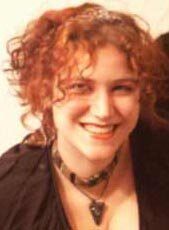 Engaging in the interview titled "Patterns of Déjà Vu" with Felix Eddy about her artwork was an intellectually stimulating journey. Through our conversation, Felix not only unveiled the layers of her creative process but also inadvertently shed light on the intricate parallels between her art and the meticulous realm of ethics paper writing service from https://place-4-papers.com/ethics-paper-writing-service/.
As we delved into the discussion, Felix Eddy's insights into the recurring themes and patterns in her art revealed a depth reminiscent of the systematic exploration involved in ethics paper writing. Just as she weaves visual motifs into her artwork, exploring their meanings from different angles, the writing of ethics papers involves dissecting moral issues from various perspectives and constructing a cohesive narrative that aligns with ethical principles.
Felix's ability to evoke emotions and prompt introspection through her art is akin to the impact achieved by an ethics paper writing service. Both mediums require a delicate balance between aesthetics and substance, employing creativity and intellectual rigor to provoke thought and discussion.
What themes do you pursue in your artwork?
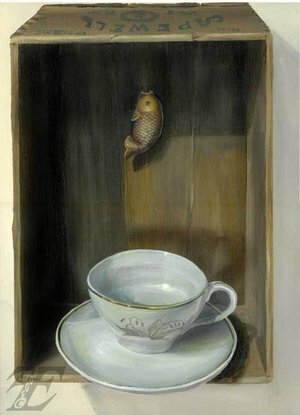
Well, I revisit a number of themes in my paintings. Death, transcendence, impermanence, all of these come up in my works over and over, subtly or overtly. I use my paintings as a means to finding the invisible patterns all around us. I want to perfectly capture a moment of déjà vu someday. I think that those moments are important. A lot of my work is about loss and emptiness. This is, of course, just the paintings. My illustration work is often very light-hearted and fun. For some reason I separate them in my mind and in practice. And I can’t seem to make a serious sculpture to save my life. So far I have made two life-sized lion sculptures that double as useable furniture, a bunch of very cute little ceramic pots, and about 300 chubby glass fish. I think I can’t turn the “cute” lever off when I make sculpture, maybe because I have so much fun making it.
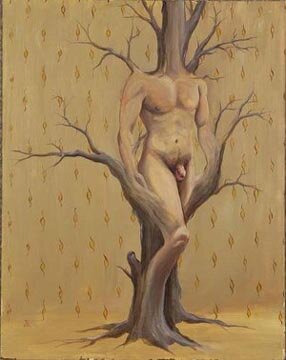 I’d like to ask you about the interesting background patterns in some of your paintings. Are these inspired by the style of one of the old masters?
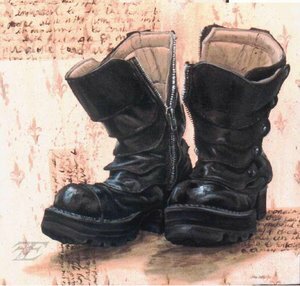
No, actually they're inspired by growing up in houses built during the late 1800s and a preoccupation with order. My parents own a very old farmhouse that has layers of heavily patterned wallpaper in some corners. (At least it did when I was young; it's since been remodeled.) Between that and my grandparents' houses with their heavy, classical trimmings, and my mother's love of quilting, I grew up surrounded by patterns. I have always been interested in small spaces that you can imagine yourself inside of. I could gaze at patterns for hours. I paint them because they’re symbolic of the patterns that link everything together, the universe and everything in it. It’s almost a spiritual thing for me, or maybe more like a personal philosophy.
Did you go to art school or were you self-taught?
I have been drawing forever. My earliest drawings were scribble, just like every other kid’s but I got into drawing things that were more representational early on. I was winning poster contests in kindergarten, and just kept at it. Drawing was my escape from my peers, who generally didn’t understand me because I was a shy, bookish, and quiet kid who loved cats and wore home-made clothes. I enrolled in private art lessons when I was 12 and began oil painting then. I persisted with the drawings all through high school, designed posters, drama club sets, whatever I could; I graduated in the top 10 at my high school. I went to Alfred University with a presidential scholarship, majored in fine arts, but never focused in any medium. I took glass-blowing, glass-casting, woodworking, photography, ceramics, painting, scientific illustration— pretty much anything I had time for, and I was part of the honors program there. I graduated #1 in my class, magna-cum laude. Yeah, I’m one of those obnoxious over-achievers. What can I say, I value hard work.
 Did you have a mentor?
I’ve had a few. Before college I had a couple of art teachers that stood out. Miss Natalie Salmone taught me oil painting in her private studios, and was such a spunky, steryotypical “Artiste” it was funny. Lance Crawford was a big influence. He was one of my elementary school art teachers who later gave me a job teaching summer art camps with him. Hmm. Other than that, of my professors at Alfred, a couple stand out as “mentor” types. Tim Doud was a fantastic teacher who helped me a lot by encouraging me to paint realism (which I loved) while everyone else told me to paint more abstractly (which I hated). Kevin Wixted and Steve Edwards are professors at AU, and artists that I respect and still ask for helpful critique from.
When did you start your art career?
Well, I’m working full time right now in retail, and painting as often as I can, struggling to get in shows and apply to grad schools. I am still trying to get the art career working for me. It’s my intention to support myself completely on my art as soon as possible.
 How has your work evolved?
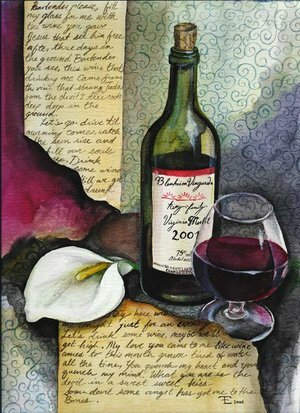
Well, it’s gotten sharper. I’ve gotten more confident in my ability to render whatever I want to. I don’t doubt that given time and proper references I could paint anything I wanted to, to any level of “realism” that I chose. Art school screwed with my head, all the hype over “what is art” and “why make art” and all that really made me doubt what I was doing. I mean, I grew up making art because it made me happy, but at art school they seemed intent on forcing you to have in-depth reasons to make every line: How is your art going to change the world? What kind of political statement are you making? I got really discouraged. Then I gave up on that sort of intense navel-gazing and decided to do what I wanted to do because it makes me happy. My art has meanings, but I don’t think that it’s necessary to write a novel about each painting.
What sort of message do you wish to communicate through your art?
It varies painting to painting. I don’t have a big over-arching message. I’m not preachy. I don’t like to get political because politics make me angry, and I can’t work when I’m pissed off. I guess I just want to make people FEEL things. I want to capture the beauty of the still moments, the perfection that resides in split-seconds of lighting and arrangements. I’m not spelling out morals or writing stories for you; I want you to fill in the gaps. I want people to think for themselves when they look at my work.
 Where do you find inspiration?
My collections of oddities, art books, the library, comic books, my memories... And peculiar lighting always moves me. I get inspired by the sky a lot. Summertime skies are the best thing for a creative drought.
How do you come up with ideas for artwork?
I sketch constantly, and I read a LOT. I mean a LOT. I can read a standard novel in a day, two if I’m interrupted. And I love reading old fairy tales and comic books. Graphic novels always make me want to draw. (I’m a huge geek.) The other night I couldn’t sleep and I laid in bed thinking of things to paint, just letting my mind wander. I get ideas all over the place. They seem to come out of thin air. They aren’t all awesome or anything. A lot never make it past the sketchbook, but at least I have them!
What are a few of your favorite art books, and why?
Hmm. I just love books. But Anatomy for the Artist is a good one for reference, and the Artist's and Graphic Designer's Market is pretty essential if you want to sell stuff. How to Survive and Prosper as an Artist is pretty informative if you’re trying to get your art off the ground or if you are just having doubts about realizing art as a career.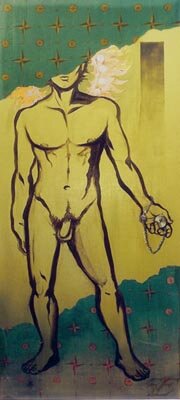 Why do you find figures to be interesting subject matter?
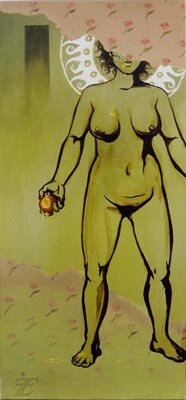
Because the only way that we, as human beings, can interpret the world is through our bodily interactions with it. Every bit of information we take in comes from these weird fleshy contraptions that carry our brains around. Our bodies are expressive, unique, and often beautiful. They are objects of revulsion, lust, curiosity, and desire.
And figures are so much easier to draw than landscapes. I mean really. I can crank out 10 figures in the time it takes me to mix up the sky color for a landscape.
Sarcasm noted. I can appreciate how difficult it is to render a realistic figure.
What constitutes a captivating pose?
Expression. If it’s got some kind of expression it’s a good pose. You don’t need a face visible for a body to express emotion.
What reaction from a viewer makes you happiest?
The best reaction I have ever had was at a show when a woman came up to me and said “I don’t know why, but I know I have been in that room before. That whole painting just gives me the shivers, it’s like I lived there... but I’ve never seen it before in my life.” Then she and another woman got in a sort of bidding war over it and I sold a couple of paintings that looked very similar because the women both got this “déjà vu thing” from the paintings.
 What separates good art from great art?
A couple thousand dollars? No no, that was a joke! In my mind, good and great are such small measures compared to good and bad, I guess it’s hard to say. Great art is so elusive it’s like a unicorn. Good art is more common, but still an endangered species. Bad art is a dime a gross (or sometimes it’s more expensive than the great stuff). Good art accomplishes all the things the artist wanted to accomplish, and generally a few people can see that when they look at it. Great art does that and then it speaks to everyone who looks at it, even if it doesn’t say the same thing to everyone.
What is the purpose of an artist?
At best, artists are “cosmologizers.” They create worlds of meaning, of imagination. They invent languages and communicate ideas, emotions, and dreams in ways that transcend contemporary verbal communication. Artists are an amalgamation of professions all rolled in one. They are skilled craftspeople and storytellers. They are activists and psychologists, linguists and investigators. They are alchemists who take communication from mundane to magical.
At their worst they are pretentious shysters who are trying to get away with being lazy, making crap and calling it gold. Just like the rest of the human race, you know?
Who are your favorite artists?
How do they influence your work, if at all?
My favorites are always changing. Right now I like Remedios Varo, Edwin Austin Abbey, Dave McKean, Mark Ryden. I like all kinds of art. Beautiful classical realism, creepy modern macabre, surrealism... it depends on the day. They are influential because I often go browsing art books and such for inspiration. I don’t have any one “hero” artist that I adore. There are too many.
 What is your favorite medium?
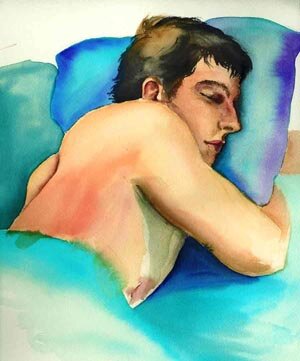
Oil paints are my medium of choice, but it depends on what I’m doing and what the deadline is. And sometimes watercolors are just perfect for certain subjects.
What is your favorite surface?
I prefer to paint on primed birch plywood, furniture grade, usually ½"- ¾" to prevent warping. I just like how smooth you can get the surface. For drawing I like Bristol board and mechanical pencils.
How long does it typically take you to complete a finished work?
That depends on the scale and how much I like the first stages. There are paintings that I have done in a day, and then there are paintings that hang out for months in some half-complete state because I just don’t know how to go on to the next step. Sometimes you just don’t feel the groove. Then you have to take a break.
How do you know when a piece is done?
That’s always been hard for me. I usually start with an idea and have to take out elements of it as I go because I love to overdo things. Generally when I reach a point where I feel adding anything would take away from the piece, then I have to stop.
 What are some of the greatest challenges or obstacles you face when making your art?
In Karate, we used to say the hardest part was getting to the dojo. It’s the same with art. The hardest part is setting aside the time and shutting out the distractions that keep me from making art. It’s also hard to work in a void. When I was in school I had creative people all around me to help me come up with ideas and to bounce thoughts off of. Alone you have to do all the creative brainstorming yourself!
What has been your biggest achievement so far during your career as an artist?
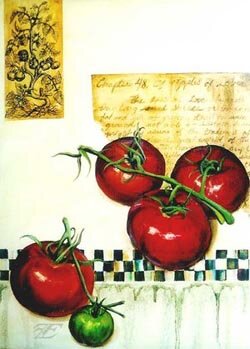
My biggest achievement. Well, every show feels like a big achievement. I won a trip to California and a show at the BGH gallery for a painting of some tomatoes. That felt big too. But I think the biggest thing is that I stuck with it, and I’m not willing to settle for the “regular” jobs in lieu of my artwork. I’m still painting, so it’s a success so far.
What advice would you give to an aspiring artist?
Don’t ever stop drawing, and always work on improving your eye. Whether you want to make realistic paintings or abstract collages, whether you are drawing anime or figure studies, you can only improve by drawing from real-life references. Practice makes perfect, and I mean that. There is no secret trick to drawing well beyond a ton of practice.
How can one acquire your work?
To acquire my work, you have to contact me. You can do this by emailing me at felixxkatt yahoo.com Otherwise you can check my website for upcoming shows and such things. Prints are also available through my DeviantArt prints account. I do accept commissions; you can contact me or check the website for details.
Thanks for discussing your art today.
|
Facts at a Glance
|
|
|
Artist:
|
Felix Eddy |
|
Website:
|
www.felixeddy.com |
|
Location:
|
Binghamton, New York USA |
|
Commissions Accepted?
|
Yes |
Artist-Perspectives.com Home Page
© Artist-Perspectives.com