
Art is the Truth
An Interview with Joseph Larkin
|
Joseph Larkin is a skilled draftsman and painter whose works are rich in symbolism and allegory. His compositions are sometimes surreal, sometimes humorous, and very often thought-provoking. In this interview, Joseph shares his perspective, giving us a deeper understanding of his art. — Editor |
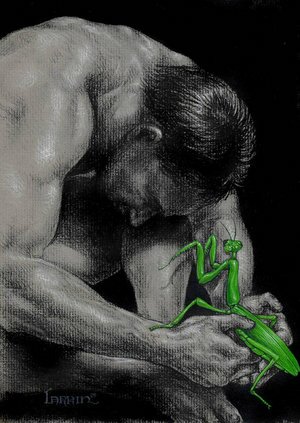
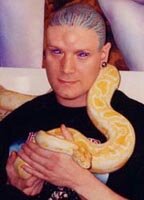 There are several recurring themes in your work: skeletons, snakes, insects, dinosaurs, and of course human figures. Often they are combined into a bizarre composition, such as a dinosaur interacting with a human. Could you explain the significance of these subjects?
"Art is the Truth - An Interview with Joseph Larkin" is a captivating glimpse into the creative mind of a talented artist. This insightful interview offers a deep dive into Joseph Larkin's journey as an artist and his unique approach to expressing truth through art.
As a reaction paper writer, I found Larkin's perspective on art and truth to be thought-provoking. His belief that art serves as a mirror to society, reflecting its complexities and contradictions, resonated with me. Larkin's assertion that art has the power to challenge norms and provoke critical thinking is particularly compelling. It reminds us that art is not merely decorative but a powerful tool for social commentary and change.
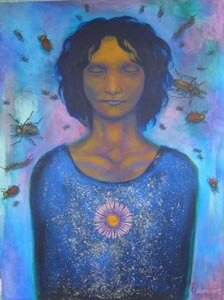
Sure, the insects and reptiles are often meant to emphasize the animals that were here before humans—LONG before humans. A lot of people seem to believe on some level that time began with humans. On the scale that life has existed on this planet, we've been here for about 14 seconds. We're arrogant enough to think that we can just take over the place and that we'll live forever. It's silly really. We are the infants that have placed ourselves in the role of gods. I suppose that I use the older animals (especially the ones that aren't extinct yet) as a reminder of humility.
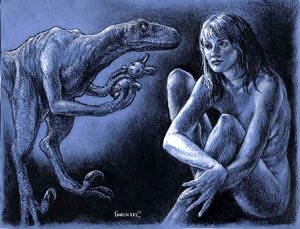
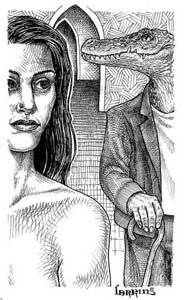
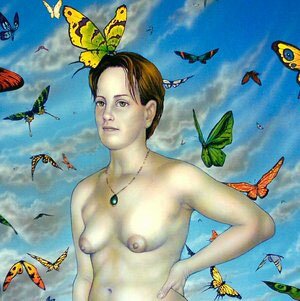 For the dinosaurs, it's a little different. Dinos are a parallel to humans for me. They were ephemeral. They came and they went. Usually if I put a dinosaur into a painting with a human, it's meant to symbolize an old man, sometimes wizened and kindly or sometimes wretched, depending on the context. In the paintings I usually cast reptiles as male.
What is the significance of reptiles being male?
Actually I tend to think of lizards, turtles and dinosaurs as male, not really snakes. I'm not exactly sure why. I guess when I look at them something in my mind just registers them as "old man" or "baby boy," depending on the individual animal. It's hard to explain because it's been that way for so long. As far as dinosaurs go, it's a little more complicated. They appear male to me in the bones—which is all we've ever truly seen of them I suppose—and in stillness, but to see one in motion in the movies or represented in motion in still art (drawings, paintings and sculpture) the quick, graceful gestures and flow are interpreted as female to me. I know, it doesn't make too much sense. It's just how it is.
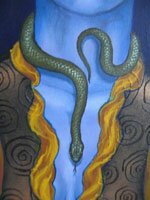
 Now snakes are another matter. When I see "snake" I think "female." I realize that's probably the opposite of most people, what with the whole "Satan" image and all, but one must remember that they were goddesses first. People argue that they appear so phallic and therefore remind them of the male gender, and I guess I can't argue that, but I just don't see it that way. Besides, their movements are so flowing and graceful, it's like watching a woman dancing. To me it seems totally feminine.
Can you interpret some of the other common symbols that your use?
Sure. Some of it's traditional stuff, like a snake representing fertility and wisdom, but I add my own stuff to it as well. But because I live with snakes and deal with them on a daily basis, I have a more personal meaning for them as well: to love while expecting none in return, to appreciate the unique beauty at face value, and to look beneath the surface of form to the common things that all living beings share. I use centipedes to represent fear, flowers to represent sex and transience, dogs to represent fidelity and subservience and sometimes protection. Birds I usually use for a sort of elevation—nothing new there. Of course you have to consider the context of it all. I guess anything can mean anything in symbolism, which makes it sort of complicated, but I try to use it with an emotional or intellectual temperance that makes it easy to read. I'm not really trying to paint enigmas here. I don't use a language that no one else can understand. I think that artists that do that are psuedo-intellectual masturbators.
 I find it very interesting that you have such a positive image of snakes. I would expect that to most people they represent something negative, like fear or even evil. Then again, most people probably couldn't fathom having pet snakes.
I love having them as pets. I won't keep venomous ones. I have nothing bad to say about people who do (as long as they're very responsible) but I won't chance it. A snake isn't a cat or dog, they're never really tame and they don't love humans, no matter how friendly they seem. It is in their nature to bite. As long as there is that understanding, they can be safely kept. Maybe it is that aspect of them that causes fear and makes people perceive them as "evil". Or maybe it is that they don't have facial expressions like some other animals, and appear alien in form. Who can say for sure? There isn't any real need for unreasonable fear here, but show some respect. Actually, that goes for all animals.
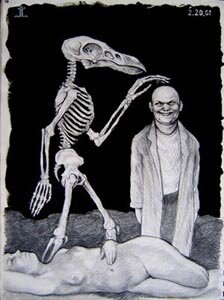 Some of your compositions seem so far fetched, and the characters are sometimes very odd. Do you intend for your work to be humorous?
Oh yes, absolutely. I paint and draw with a great deal of humor. Sure, there are times when things are dark, but even in those pieces I try to add a dash of comedy or absurdity, and I try to do so without using much irony, because that's whiny. One of my favorite quotes is, “Those who shun the whimsy in things will feel rigor mortis long before their death.” It’s a line from Still Life with Woodpecker by Tom Robbins.
What themes are you pursuing in your artwork?
Visually, human figure and animal figure compositions. Conceptually I try to focus on the relationships between living things and each other and the world around them.
Do your works have a message?
Usually there's a message there, one pretty much anyone can read. Often I hide a few things beneath the surface to make things fun, but there's always a way to get there on your own. Sometimes people interpret my work and come up with something profoundly deeper than what I had intended. I LOVE when that happens, and I tell them so.
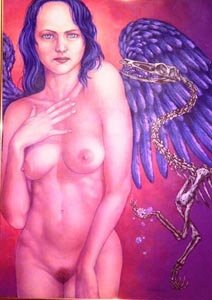
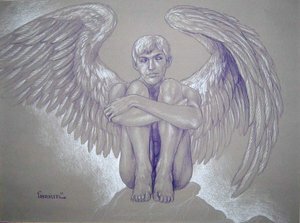 Could you tell me about your series of angel drawings?
Sure. My basic idea was to do a series of nude angels—male and female—with only the following boundaries: same type of paper and matboard, a different type of purple pencil for each one(with white chalk)and that no two should be the same model or pose. That was pretty much it. And the series has remained within those boundaries. I guess to exit those rules for me would be to work outside the series.
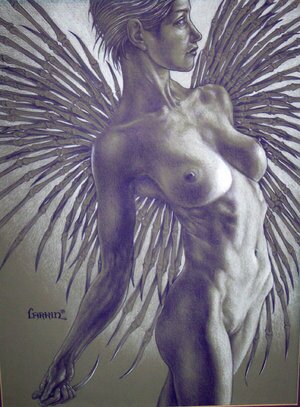 Why do you find figures to be interesting subjects?
The human figure is a subject we can all relate to. They are us. It speaks a language that all humans understand, whether in cave paintings, religious text, or pornography.
What constitutes a captivating pose?
Good lighting, tastefulness, mechanics (what can the body do?), environment, props (I often use them for symbols), expression (facial and otherwise), and body language.
In your artist’s statement you said that art is “for, in, and because of everyone.” Could you elaborate?
Sure, I view art above human construction, but humanity is a part of art, as is all life. I guess if there is a god, I would call that art. The ability to create, perceive, and appreciate is all artistic. All that exists, be it positive or negative, is art. Ghandi, Hitler, and yes even Picasso were artists. I know this may sound like over-simplistic bullshit, but it really is the way I see things.
 Your artist’s statement concludes with “Art is the Truth.” Could you explain?
Art is.
Couldn’t an artist paint deception and lies?
Ho ho!! I said art is the truth, not that artists are truth tellers! In fact, there is a whopping dichotomy at work here because by definition artists are liars. With the exception of abstract artists who create wholly nonrepresentational art, we all create two-dimensional forms based on a three-dimensional world, be it a real one or not. That, or three-dimensional objects based on separate idea or identity. It's all artifice, this thing we do. Art itself is the truth. It is the muse, the energy, the spirit. It's just that humans are limited in what we can do with it. I don't think we mean to lie; it's just that we as a species are limited by the boundaries of what we can create. I know I've contradicted myself about a thousand times here in a thousand different ways. It's the best I can do. I don't mean to be confusing. I just have trouble explaining it. Bear in mind also that I'm not trying to present all of this as factual. It’s just the way I feel about it.
 Did you go to art school?
I went to community college for art, to learn rules and techniques. They were very helpful and instructive.
When did you start your art career?
I'm not sure I did.
Why do you say that?
I don't think I really have a career. It's just what I've always done. While "artist" is the word I chose to describe myself, I look at it more as a necessary action than a career move.
How has your work evolved?
I hope it has! I try to grow with each new idea. It doesn't always work, but I like to think it does sometimes.
What is your favorite medium?
There’s nothing I won't use, but my favorite is oil.
How long does it take you to plan a composition? How do you decide what to paint?
That varies so much from piece to piece. Sometimes I have the whole composition/concept done before I even pick up a pencil to sketch. Conversely, there are some ideas I have been kicking around for a decade that I still haven't thought through to the end of even the preliminary stages.
 How long does it take you to complete a finished work?
Anywhere from five minutes to two years.
When you say two years, do you mean from the first brush stroke until the last?
Yes. Sometimes there are long pauses between stages, just so I can be sure I'm doing exactly what I want to. Also, there are lots of layers and stages in the technical aspect of the way I paint.
What is the greatest challenge you face when creating art?
To create often and well, and to try to move above my current ability.
What reaction from a viewer makes you happiest?
They find some element that they can identify with. That, and an appreciation for craftsmanship, the time and effort that went into it.
What do you think separates good art from great art?
Effort.
 What do you think has been you biggest achievement so far during your career as an artist?
To remain an artist. There are easier paths.
Have you any regrets in terms of taking your career?
(Laughs) I'm broke a lot.
What advice would you give to an aspiring artist?
Create as much and as often as you can, and try to be honest. Don't rely on drugs to help creativity. They don't. And it doesn't look as cool as drug user think it does.
How can one acquire your work?
The best way is to contact me on my website.
Thanks for discussing your artwork today.
|
Facts at a Glance
|
|
|
Artist:
|
Joseph Larkin |
|
Website:
|
http://www.josephlarkinart.com/ |
|
Location:
|
Columbus, Ohio USA |
|
Commissions Accepted?
|
Yes, send email for terms. |
Artist-Perspectives.com Home Page
© Artist-Perspectives.com