
Vision of a Colorblind Artist
An interview with Royce Deans
|
Royce Deans is an accomplished artist whose work has appeared in American Artist magazine. His paintings grace the walls of McDonald's restaurants around the world, but his passion is painting the human figure. This interview includes a crime drama, music, and plenty of food. What more could one ask for? — Editor |
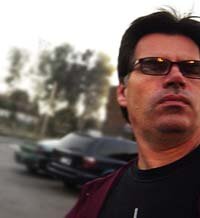
"Vision of a Colorblind Artist: An Interview with Royce Deans" offers a unique and thought-provoking glimpse into the world of artistic expression, shedding light on the perspective of an artist who navigates his craft with a distinctive perspective. This interview not only unveils the intricacies of Royce Deans' creative process but also draws an intriguing parallel that underscores the difference between a book review and a book report.
In this insightful interview, Royce Deans' approach to art as a colorblind artist challenges conventional norms.
In your artist's statement you mention that you are colorblind. A colorblind painter sounds so ironic. How has that affected your style or methods?
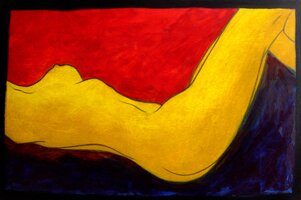
My "hue challenged" situation has affected my style, and probably even more so my method. For years I frustrated myself trying to do things right. Then, three years ago I had a sort of a rebirth experience. I was told about a show—in a gallery in Salt Lake City, Utah of all places—that was going to be all nudes, and they had put out a call for entries. I had been experimenting with some compositions that were nude figures crammed into tight box-like spaces. My preliminary drawings had heavy black lines in them and they made me think of stained glass windows. So I started filling in the spaces in and around the figures with the brightest colors I could find. Most were right straight out of the tubes. I was completely intoxicated. I did four paintings for that show and all of them were accepted. That was all I needed. I spent the next nearly two years working out a technique that involved paint right out of the tube being spread around with plastic bags that I got from the grocery store.
So, to answer your question, I pretty much gave up on color and it took care of itself. I kid myself from time to time that I know what I am doing, but then I come to my senses.
 Why did you paint with plastic bags instead of brushes?
For many years I tried to get acrylic to act and look like oils by using conventional brushes. With the bags I could spread the paint in the sort of layers I liked, and that allowed enough of the lower layers to show through, giving me the effect I really liked. As well, when I would burnish the paint down a lot, it would end up with a really nice lush finish. I should mention that most of the time when I paint with bags I sand the whole painting down in between layers of paint.
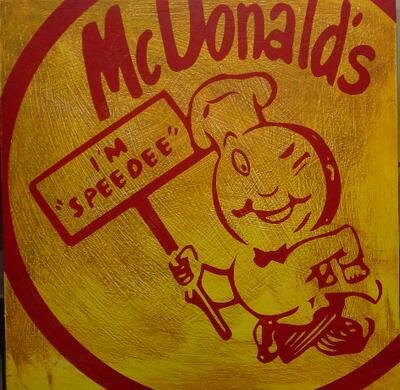 Your art is hanging in a number of McDonald's restaurants. How did that come about?
Well, it is one of those stories of being in the right place at the right time. Quite honestly I had no idea what I was doing when I first started doing McDonald's paintings. But, as for how it came about, an artist friend of mine had a friend that worked at corporate McDonald's and set my friend up with an appointment with Mickey D's art buyer. For some reason my friend thought it would be okay if came along with my portfolio to his appointment. I was petrified at the prospect, but what could they say other than no? I mean if ever there was a situation that was going to be no skin off of my teeth, this was it. I mean I hadn't even asked my buddy if i could go along. So I went, and I walked out that day with a commission to do five or six paintings.
What is the theme of these paintings?
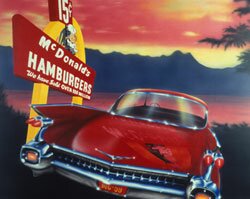
Many of them, in fact almost all of them at first were nostalgic scenes from the 50's. Lots of old cars and poodle skirts.
 How many of your paintings have you sold to McDonald's?
I wouldn't begin to know. I have not always been as diligent at documenting my work as I am now. About ten years ago I did do 20 five-foot by six-foot paintings for a franchise owner in Beirut. They were all different past, present and future scenes. I have no idea if those paintings still exist. My guess is that some of them probably had their value enhanced with a few bullet holes at least.
How many restaurants are displaying your work?
I wouldn't know that either. Initially my work was only in regional offices or in the corporate headquarters, some were even in Hamburger University. Actually the only painting of mine that I know was stolen was taken from the walls of Hamburger U.
Wow! The great Hamburger Art Heist! I can see it now: glass cutters, laser beams, security guards bound and gagged. Sounds like a case for Lt. Columbo.
Well, continuing on the food theme, I understand you've painted with soy sauce.
Anyone that knows me very well will know that food is very important to me. My wife thinks it is way too important to me. (What does she know?)
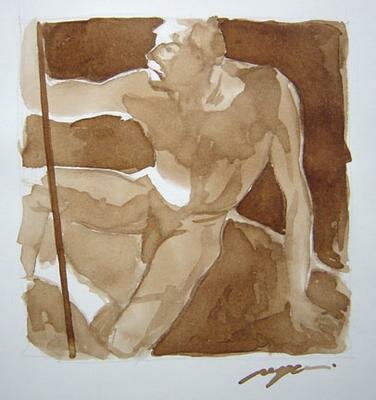 Why did you try that, and how did it turn out?
I am always looking for something alternative. Let's face it, when we consider the history of artists from the beginning of time, it has got to be a small percentage that actually used paint squeezed from a tube. I only did a couple of soy sauce paintings, enough to understand what is involved there. I think it has a nice effect. A nice soft sepia tone. You do have to build up a few layers in order to get any good darks. I suppose my favorite part is the salt crystals that appear on the surface of the paper when the it is dry. They sparkle.
I understand that you owned and operated an art gallery at one time. Tell me about that experience.
This was not the worst time in my life—far from it. In fact it was pretty fun. I dealt with local artists. I think I had about 27 that I was showing by the time I gave it all up. It came down to what did I want to do? Did I want to be a gallery owner or an artist. I didn't think I was being that good of a gallery owner, so I bailed.
 As a former gallery owner, do you have any interesting insights or tips to share with artists or art buyers about the commerce of art?
Perhaps the "former" part of this question is all you need to know. I had a lot of fun running the gallery. I met some really excellent people and learned some valuable lessons, but I don't think I was a very good gallery owner. Tips to share? Most artists do not make good art dealers. The notion that "if you build it they will come" does not really hold too much water in the art world. To artists wanting to be part of the gallery scene... well that is a long subject and I don't think anyone really knows all the answers. Show your work to everyone that will look.
You publish an indie-rock publication called Copper Press. That sounds like an interesting job.
Job and interesting don't always go together that well, but Copper Press is that. And if I were to think about it, it is pretty darn interesting. I have a partner that does all the ad sales and oversees the editorial content. I handle pre-press production and design. I guess I am the art director. I get to to listen to a lot of crazy music. That in and of itself is interesting. Maybe my favorite part is that we also feature a fair number of artists, from all over the industry and people that are involved in some really creative endeavors. I do a lot of the interviews with these folks, and I should say that it keeps me on my toes.
Is it true that you also run a record label?
Yes. Sometimes I feel like the guy on the Ed Sullivan Show with the act where he would spin the plates on those sticks, running all over the stage to keep them spinning and avoid them crashing to the floor. A few years ago my partner in Copper Press Steve Brydges and I decided to make a go of helping his life-long dream of owning and running a record label come true. We started 54º40' or Fight! and now we are now thought of as legitimate players in the world of indie rock.
 When did you start your art career?
I always drew, but I was never any good. I loved art as a kid. When I look back at my high school sketchbooks, I can honestly see why no one ever encouraged me. I was a late bloomer. I must have been nearly 22 before someone saw any merit in any of my drawings.
Did you go to art school, or were you self-taught?
Yeah I went to art school, the American Academy of Art in Chicago. I majored in illustration and design. I suppose in most people's eyes that would take me out of the running for self-taught artist of the year. I can't really look back on my art school experience with too many fond memories except for the life drawing classes I took. There were lots of assignments in school, but I have to say that I taught myself.
 What specific themes do you pursue in your artwork?
I used to try to be all cryptic. The problem was that I didn't need to be. As it turned out, the messages that I was trying get across were so convoluted that turning them into cryptic messages made them totally indecipherable. So, now I have taken to much simpler themes, such as universal emotions and feelings that all of us have at one time or another.
What sort of message do you wish to communicate?
Different things speak to me at different times, and I like to just go with it. Going with the flow feels so much better than trying to contrive anything too creative. Chances are I will only outsmart myself and end up saying nothing... how sad is that?
Who are your favorite artists?
Picasso, Matisse, Monet, Van Gogh, Gaugin, Warhol, Andrew Wyeth, Jackson Pollack, el Greco, Robert Motherwell, Rodin, Egon Schele, Modigliani, Philip Pearlstein, Fernando Botero, Tom Wesslemann, Paul Cezanne, Tamara de Lempicka, Balthus, to name a few.
That's a rather diverse list. Andrew Wyeth and Jackson Pollack? Elegant realism and splattered paint. Can you elaborate on how some of these influences have impacted your style?
Each one in a different way I suppose. My mother always talked about Andrew Wyeth. It wasn't until I was in art school and working in watercolor that I really began to understand his style and how perfect it was for his subject matter. Of course several years ago when the Helga paintings came to light, I had one of those moments.
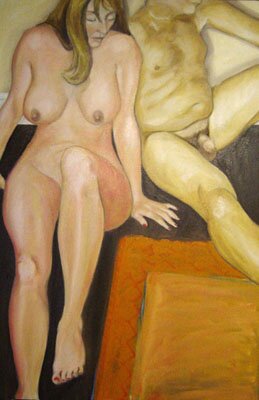 As for Jackson Pollack, at a time when everyone else I was around would see his work and say any kindergartener could do that, I was spellbound by the rhythms, the texture, and the immensity of the canvases. I am still seduced by the emotion induced by what seems to be a random field of paint spatters. I see the natural beats and rhythms and movement that I see in nature, and all those things are things I see in the figure.
I should say that when as a boy of 14 I first saw two paintings by Philip Pearlstein at the Art Institute in Chicago. It was then that I knew I wanted to paint the figure.
Seems like a major turning point. Tell me about those paintings and why they inspired you.
I wish I knew specifically what paintings they were now, but I remember as young person standing there in awe. In awe at the honesty that the painter was employing here about the human body. I didn't know too much then about anything, but I knew that I would never forget. The beauty of the rawly lit figures, their close proximity to each other and the lack of sexual tension shown as they were posed so intimately. To me as a teenager trying to figure things out, this was a real revelation and a relief. I am not sure if it really changed the way I lived my life, but I know I have appreciated the insight it gave me so long ago.
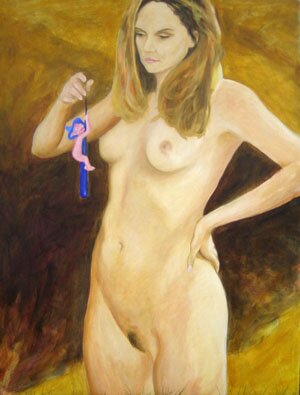 Why do you find human figures to be interesting subject matter?
For me, it is the highest form of art. I can't speak for others, but even when I do a non-objective/abstract painting, the human figure and it's shapes and contours are what my brushstrokes are following. The human body is the greatest of all the creations of God, and while I don't think I would ever take upon myself the responsibility of doing a painting of God, painting the human figure is for me I suppose, a display of reverence to God.
What constitutes a captivating pose?
One that talks to me.
Where do you find inspiration?
In daily life. Mostly from other people just being themselves. I love people and the things they do.
How do you think up ideas for artwork?
Specifically? Very often I will see a shape either in my head or in nature, or in a stray pencil mark in my sketchbook that speaks to me. I will do a thumbnail sketch of how that shape may translate into a pose. By this time I will usually have a model in mind that I would like to see work with this idea. The final pose may not resemble that original shape, but it was the genesis; it was the seed that it grew from.
What is your favorite medium?
Right now it is oil. I am using some great walnut oil based pigments that are made by M.Graham & Co.
How is this different than any other oil paint?
I can't claim to be any sort of expert on oil paint, but I do know that I am very pleased with the consistency of the paint and the intensity of the pigments. They are prepared very carefully. They are so creamy to work with — so much so that I need to be careful that I don't just end up smearing them all over my studio.
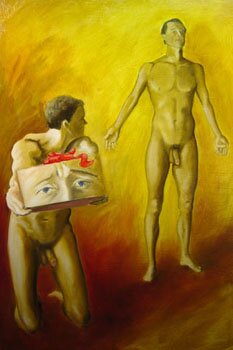 You recently switched to oil paints after using acrylics for a long time. Why did you switch and how is that affecting your style?
The same thing that kept me away from using oils is what brought be back to them. The idea that they have this long drying time always made wary. But as I have worked with them I have found that that is not a big obstacle, and in fact it isn't always true. I became particularly frustrated with acrylics while painting some life-sized figures a few years ago. The paint would dry before I got even one leg painted. I knew then that if I was going to keep doing this type of work that I was going to have to switch.
Even as I was planning my first oil painting, I fully intended to be making paintings that looked just the same as I was doing in acrylic. Magically, as soon as those first brushstrokes of paint went on, I knew things were going to be different from here on out.
I really feel my approach to the figure is pretty much unchanged and unaffected by whatever medium I choose even if the end results are quite different. I am not sure I understand how this works really, it must just be my bio-rhythmic response to the different mediums that makes what happen, happen. Even though it has been months since I have gotten out my acrylic paint, if I were to do so today, I think the results would be the same as though I had be using them all along.
How long does it typically take you to complete a finished work?
I wish I could say for sure. I know I could make the overall time a lot shorter if I had a lot more confidence in myself. It is so hard for me to call a painting complete. Very often in two days, I will see the magic appear, and maybe someday I will be able to live with that.
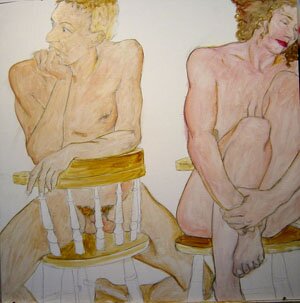 How do you know when a piece is done?
I work on a painting until I basically get stumped, then I will put the piece aside and live with it propped up in the corner of my studio for a couple weeks, or in some cases months. After a while I get the painting out again. When I do it is almost always obvious what I need to do. Sometimes it is only a small thing. Other times it is a lot. Nine times out of ten I know just what needs to be done.
What reaction from a viewer makes you happiest?
Depends on who is viewing. "I'll take it!" is always a good one. If it is a friend, I think just about anything positive is a good reaction — although a bad reaction is okay too, as long as they point out the one thing that I know is wrong with the piece. But the best one is when the model I drew from tells me that I captured "them" or when I am told by the model that the piece I just finished brought tears to their eyes. It doesn't get any better than that.
What is your favorite art book?
Hmmm, that is a hard one. There are so many, but I guess if I had to chose I would pick The Art Spirit by Robert Henri. By the way, I just saw a woman's portrait by Robert Henri at the local art museum here in Traverse City. The painting is on loan along with a bunch of other American painters from the Detroit Institute of Art. Anyway, I was knocked out by this painting.
What do you think separates good art from great art?
Isn't that the question we are all trying to find the answer to? I am not sure I can answer that one, not without writing a book. Chances are it would be a more interesting book than the one about my own person journey through life as a colorblind artist.
Thank you, Royce. It's been a pleasure chatting with you today.
|
Facts at a Glance
|
|
|
Artist:
|
Royce Deans |
|
Website:
|
http://www.roycedeans.com/ |
|
Location:
|
Acme, Michigan USA |
|
Commissions Accepted?
|
Yes, but very selectively. |
Artist-Perspectives.com Home Page
© Artist-Perspectives.com